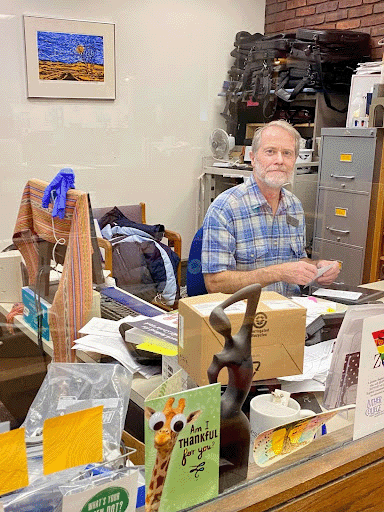
On a quiet January afternoon at Luther College’s Preus Library, Eddy Atwell stood behind the circulation desk with a sense of relief. His replacement had started that day, giving them three weeks together to train before his retirement at the end of the month. Few students have ever noticed how much planning, precision and people management it takes to keep that desk running, until now.
“I’m excited because my replacement started working today,” Eddy said. “We’re going to have three weeks together to train, I was afraid she’d come right when I was leaving and there would be a rush job.”
After 34 and a half years at Luther College, Eddy retired at the end of January 2026. In his final weeks, he trained his replacement while preparing to step away from a position that had made him a familiar presence in the daily lives of students. His career reflected the behind-the-scenes people management and operational work that keeps campus services running smoothly. His retirement marked not just the end of a long career, but a transition in how institutional knowledge and workplace culture would carry forward at the circulation desk.
For Eddy, consistency at the desk was never optional, it was essential. “We always have to have someone staffing the circulation desk [at] every moment,” Eddy said.
Eddy began working at the library part time, covering evening shifts while raising two young children.
“That worked with my life because I had two young children at the time,” he said.
What began as a practical arrangement became a career shaped by consistency. Over time, Eddy moved into a full-time role and became the steady presence behind the circulation desk, a job that requires constant attention even when it appears routine.
The circulation desk functions as a hub for basic library services: checking materials in and out, answering questions and directing patrons to the appropriate department. According to the Luther College Library’s services information, circulation staff assist with returns, recalls, technology checkouts and access to other student-facing services, operating alongside research help, reserves and interlibrary loan.
Eddy described the job as a blend of customer service and logistics. “We’re putting things away, retrieving things for people,” he said. “In addition to books and DVDs, we also have a lot of technology equipment that we check out.”
Much of the work involves knowing where to send people next. Students often arrive with questions beyond circulation, Eddy said, making referrals essential.
“We might give very early help,” he said, “but we refer people to the librarians for more in-depth research help.”
The pace follows a predictable rhythm. Eddy said, “Two to four and six to nine are usually the busiest.”
During midterms and finals, staffing stays the same. “We just work a little faster,” he said. That efficiency matters, because small mistakes can disrupt the system.
“If we put things in the wrong place, no one can find them,” Eddy said. “They’re basically lost.”
Accuracy and preparation form the backbone of Eddy’s management approach, especially when working with student employees. He estimates he has worked with hundreds over his career.
“I used to have about 22. Now I have about 15 to 17,” he said, estimating “close to 300 to 400” students overall during his years at Luther.
When asked what makes a strong student employee, Eddy didn’t hesitate.
“The number one priority is the ability to come to work and be punctual,” he said. “We have to have someone at the desk.”
Beyond reliability, he emphasizes service. “The line I always say is, we never say, ‘I don’t know, go away,’” Eddy said. “It’s, ‘I don’t know, let me help you figure it out.’”
Training reflects that mindset. Eddy said students receive about six hours of initial instruction, guided by a checklist, but real learning happens over time.
“I don’t really expect them to memorize stuff,” he said, noting that some responsibilities only appear at certain points in the academic year.
That long view also shapes how Eddy handles mistakes. “I’m quick to acknowledge when we make a mistake and quick to fix it,” he said. “But I also hold people accountable.”
Policies provide structure, he said, but judgment matters. “We have default answers to almost everything,” Eddy said. “But that doesn’t mean we can’t adjust depending on what’s going on.”
That balance defines the work environment, according to Kwaku Junior Sarpong (‘25), a student employee who has worked at the circulation desk for three and a half years.
“I’ve never seen him stressed,” Sarpong said. “Everything is always under control when he’s around.”
He described Eddy as dependable and steady, noting that working with him shaped habits that extend beyond the job.
“I’ve learned to become very punctual, dependable and reliable,” Sarpong said. “I’ve also learned to care about the folks I work with as human beings.”
Managing student employees also means planning for turnover. While most changes are predictable, Eddy said unexpected gaps require quick adjustment.
“I have a hole in the schedule that I need to worry about,” he said, explaining that he keeps a pool of applicants and tracks availability to fill shifts quickly.
Over 34 and a half years, Eddy has also overseen major changes in library operations. When he started, card catalogs were still in use.
“We had cabinets with cards that told you how to find books,” he said.
As systems moved online, circulation shifted toward technology access and digital support.
“There was more efficiency,” Eddy said, “and less need for us.” Even so, the desk remained a key point of guidance and connection.
Sarpong expects the change to be felt. “Those are some very big boots to fill,” he said. “The culture of the circulation desk will definitely not be the same.”
Eddy doesn’t deny that his departure marks a shift, but he doesn’t see retirement as disappearance. Living near campus, he plans to return to the library and stay connected.
When asked what he hopes students remember, Eddy smiled. “I hope once in a while they might think, ‘Oh, I liked that guy back in the library,’” he said. “I was a good boss.” He paused, then added the principle that guided his management for decades. “That’s why I’m never upset when somebody makes a mistake,” Eddy said. “I just want to set it up so it doesn’t happen next time.”